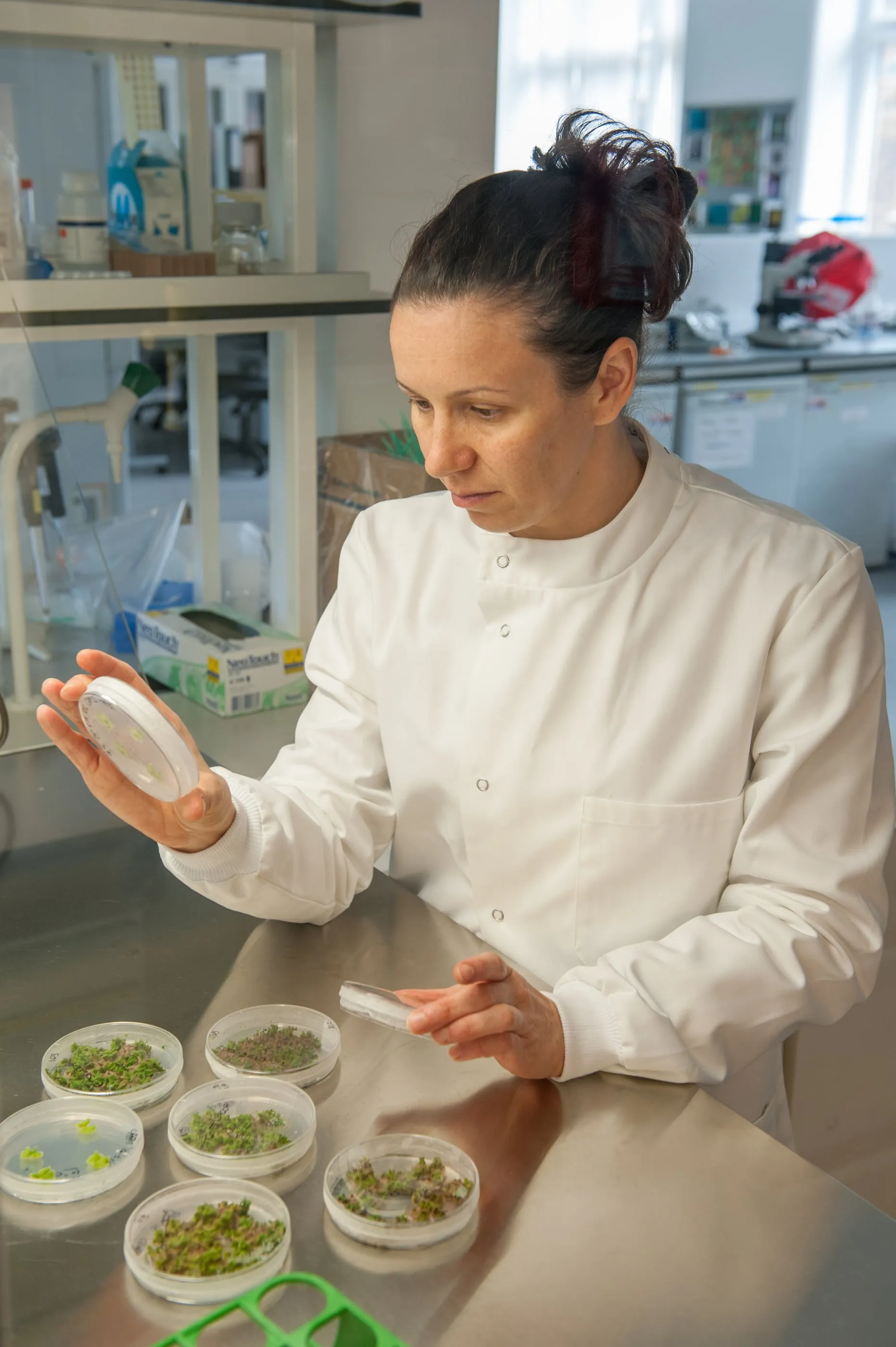
Anybody who works in a lab can spot fake lab photography instantly. Two people in unnecessary goggles, holding a conical flask of blue liquid up to the light, wearing gloves for a task that needs none. It is the visual equivalent of a stock phrase, and it undermines the exact audience you are trying to reach: the researcher deciding whether to apply for a job with you.
Real work looks different, and better
The frames that convince are almost always the unremarkable ones. Somebody loading a plate reader with their back half turned. A tray of seedlings under grow lights. A hand-written label on a flask. Two people arguing at a whiteboard about a result.
None of that needs arranging, which is the point. It also needs a photographer willing to wait, because the interesting thing happens on the lab’s schedule, not on the shoot’s.
Talk to the lab manager, not the marketing team
The marketing brief tells me what pictures you need. The lab manager tells me what is actually possible: which rooms I can enter, what is under embargo, which instrument is mid-run and cannot be interrupted, and whether the interesting part of the protocol happens at 9am or 4pm.
Ten minutes on the phone with them before the day reliably saves an hour on it.
Induction, PPE and the things that are not negotiable
Most sites want a photographer inducted before they walk in, and that is entirely reasonable. Lab coat, safety glasses, closed shoes, whatever the room requires. I follow the site’s rules rather than my preferences, and I have never met a safety officer who objected to being asked first rather than after.
Equipment matters here too. I keep the kit minimal in a working lab: one camera, one lens, no light stands blocking a walkway, no cables across a floor somebody has to cross carrying something.
Confidentiality is easier to handle before the shutter
Every lab has things that must not appear in a photograph: a screen with unpublished data, an instrument under a supplier NDA, a whiteboard covered in a grant application, a sample from a partner who has not agreed to publicity.
The efficient version of this conversation happens before the shoot. Tell me what cannot be in frame and I will compose around it. The inefficient version is discovering it at proof stage and retouching a monitor out of forty images, which never looks quite right and costs everybody a week.
Light in rooms that were not designed for it
Labs are lit for work, not for photographs: overhead fluorescents, some LED, a bit of daylight leaking in from a corridor, and every source a different colour. Left alone, faces go green.
I mostly work with what is there and add a small amount of light where I have to, because a lab lit like a studio stops looking like a lab. Where a room is genuinely hopeless, a single light bounced off a ceiling usually rescues it without changing what the space feels like.
Portraits of scientists, done properly
The default is bad: pinned against a corridor wall, holding a piece of equipment they have never used. Given ten minutes and someone’s actual bench, you get a portrait that says what they work on, with the room falling away out of focus behind them.
For a whole department, the pattern that works is a single day. Environmental portraits of the group leaders in the morning, a matching headshot station in the afternoon, and reportage of the facility in the gaps.
I have photographed in labs at Abcam, AstraZeneca and Cambridge Plant Sciences on that basis. If you want to talk through what a day in yours would look like, the life sciences page has the detail, or just send me the date.